
Healing with the Elements



The elements were long believed to be the basis from which everything else on Earth is composed. While different traditions and medical systems around the world recognize different elements, the 4 elements of earth, water, air, and fire from Greek cosmology provide a simple yet potent framework to transform different areas of health.
In short, Earth represents nutrition, Water represents hydration, Air represents sleep, and Fire represents exercise. Let’s take a deeper look at how the elements correspond to these various aspects of health.

Earth is the most fixed of the 4 elements, and its glyph is written as a downward pointing triangle with a line through it. Earth relates to nutrition and the nourishment we receive from the food we put in our bodies.
On the most basic level, food provides us with a spectrum of nutrients in the form of micro and macronutrients that give the body energy to go about our daily lives and sustain the basic building blocks of the human body. Macronutrients provide energy to the body in the form of calories from fat, carbohydrates, and protein. Micronutrients consist of minerals, vitamins, essential fatty acids, and essential amino acids that the body cannot produce in sufficient amounts by itself, and thus we must supplement with food.
When I talk about eating health-promoting foods, I’m coming purely from the perspective of nutrient density. Is the food providing the body the nutrients it needs to sustain itself with the least amount of toxicity? If yes, then it can be considered health-promoting. On the other hand, health-diminishing foods fail to provide the body with essential nutrients , while also introducing toxins in the form of pesticides, refined sugars, chemical preservatives and so on.
There is no one “right way” to eat as there are so many food combinations out there that can provide each unique body with its own nutritional needs. To bring herbalism into the conversation, your diet is a wonderful way to get creative and incorporate wild edibles and medicinal herbs into the mix, providing an array of vitamins and minerals.
I love adding plants that blur the line between herb and food into salads and smoothies like dandelion greens, lamb’s quarter, nettle seeds, purslane, borage flowers, and nasturtium flowers. I’m confident that many people reading this right now could step outside their house and find one of those plants growing within a 1-mile radius. Of course, you want to be conscious not to harvest near roadsides or in areas where people spray, as most of the plants mentioned above are viewed by many as pesky weeds.
I also love keeping herbal-infused vinegars on hand to use as salad dressings. And not to mention all the other ways that herbs can be incorporated into the diet such as drinking tea and making mineral-rich broths and soups. Stay posted on the blog for herbal recipes!

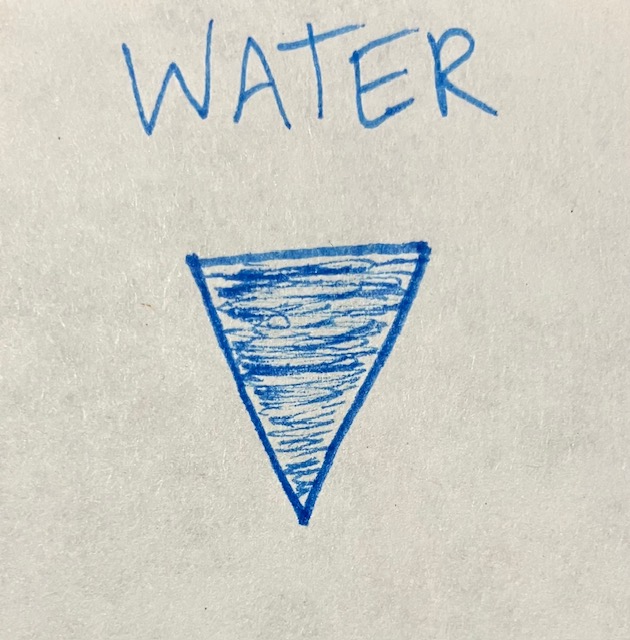
Water is life, and the water element corresponds to the hydration of both water and oils in the human body. Water is also a fixed element, but a little more fluid than the element earth. The water glyph is written as a downward-pointing triangle.
The body is made up of around 60% water and is critical for survival. While there’s never one size fits all, the average daily water intake for men is around 15 cups and 11 cups for women. A percentage of your daily water intake can also come from other beverages such as tea, coffee, juices, kombucha, coconut water, and foods like fruits and vegetables.
From my personal experience over the years, the best way to hold yourself accountable for drinking enough water every day is to buy a water bottle that you love and will carry around with you like your life depends on it. Because it does! After experimenting with different types and sizes of bottles, 32 oz. stainless steel ones are my favorite.
So when it comes to drinking water, spring water is hands down the winner in my book. I am blessed to live in a place where I have access to multiple springs within an hour’s drive from my house, and I make a ritual of filling my two 5-gallon jugs every few weeks right from the source.
For starters, nothing beats the refreshing and activating taste of cold spring water fresh out of the ground. Without any human tampering, spring water is full of essential minerals and tends to be more alkaline than tap water, displaying an entirely different chemistry than other types of filtered and treated water. Findaspring.org is a great online resource I have used for checking out what springs are in the local area and the quality of the water.
If you don’t have access to spring water where you live, mineral water is a great alternative. It is basically spring water that has an array of minerals added to it. Some of the added minerals are not essential to the body and some people may not be able to process all of them. Because of the added minerals, mineral water can have a distinctive taste that makes it not as appealing or “natural tasting” as spring water in my opinion.
Next comes distilled water in terms of quality in my opinion. After the distillation process, this water lacks the minerals and nutrients that spring and mineral water provide. Drinking this water over prolonged periods can lead to mineral deficiencies if you don’t add minerals back into the water, but the plus side is that distilling the water can remove toxic chemicals, metals, and impurities from the water. While distilled water is my last choice out of these 3 types of water, it is still better than plain old tap water in many places in the US and around the world.
While most people only think about water when it comes to hydration, I wanted to quickly touch upon the role that oils play in hydrating the body. Our nerves and myelin sheathing are coated in oils to help conduct electrical signaling up and down the nerves. When these oils aren’t sufficiently hydrated, our nerves essentially cannot communicate as efficiently or effectively, and nervous system function may become depressed over time. This is where healthy fats and oils, primarily omega-3 fatty acids, play a critical role in the overall hydration and health of your nervous system and body.

After the fixed elements of earth and water, we move to the first volatile or upward-moving element of Air, which corresponds to sleep. The Air glyph is written as an upward-pointing triangle with a line through it.
3 important questions to ask yourself when it comes to sleep hygiene are~
1) Am I getting 7-8 hours of sleep per night?
2) Is it fully dark in the room when I’m sleeping?
3) Do I wake up in the morning feeling well-rested?
Light is the most important factor in regulating circadian rhythms, as darkness creates chemical changes in the body that encourage restful sleep.
Having a consistent bedtime and staying away from artificial lights such as TV and cell phones once the sun goes down can be beneficial in promoting restful sleep. These practices also help the nervous system switch gears into the parasympathetic state of rest, digest, integrate, nourish, and process. There is also a category of herbs called ‘hypnotic nervines’ that help induce sleep such as California Poppy, Passionflower, Hops, and Pedicularis.
If you mostly sleep continuously through the night and awaken feeling refreshed and well-rested, before a cup of coffee or green tea, those are good signs things are working smoothly.

Fire is our final and most volatile element of the four. Its glyph is written as an upward-pointing triangle. Fire is all about movement, exercise, and getting your heart rate up. There are many different ways to move the body from aerobic exercise to stretching, balance exercise, or strength training.
Aerobic exercises increase your breathing and heart rate and improve the overall health of your heart, lungs, and circulatory system. Some examples are walking, running, swimming, skiing, or cycling. Everyone has their preferences and has to discover what works best for them. I find aerobic exercises to also be particularly beneficial for my mental health as they help to break up my day and uplift me while I am immersed in the beauty of nature. I have made it a regular habit to go for nature walks to help integrate and process all the stimuli of living on planet Earth in 2023.
Strength training, also known as resistance training, is using physical exercise to strengthen and tone the muscles. This can include things such as free weights, weight machines, your own body weight, or resistance bands.
Stretching is critical to help maintain strong and flexible muscles and keep a full range of motion in the joints. It is especially effective in warming up the muscles before a workout to prevent injury and helps with muscle recovery and repair post-workout. Personally, I love starting my mornings with a sun salutation. It’s gentle and quick yet does a beautiful job at kick-starting the process of waking up my body and getting my blood flowing.
The last type of exercise is balance, which simply helps to make you feel sturdy on your feet, prevent injury/ falls, and move with more ease through the world from day to day. Balance exercises help with muscle strength and joint support, which play an important role in the body’s ability to maintain balance, along with vision and the inner ear.
I hope you find some inspiration from the elements in this blog post to level up your health game and sense of well being. Leave a comment about what elemental area of your life you’re feeling called to improve.
If you are ever looking for further assistance on your health journey, consider booking a consultation with me. You can find more information on my website under the tab ‘Book a Consultation.’